Thursday, 1 September 2011

July and August Update - A weekend on the Scillies (Day 4)

Our final day on the Isle of Scilly..... everyone had woken up a little groggy from the cursory celebratory drinks the night before, so, to clear heads and make a good start to the day we decided to go and have a nice and greasy cooked breakfast before heading up to the north of the island to look for the Bee-eater that had been hanging around for the summer. The debate was which cafe to visit.... the one near the bank in 'town' or the one a bit further out in Old Town..... the latter was chosen - unbeknownst to us this was to be a great decision.

After arriving at the cafe and ordering, we went outside and sat at the tables, chatting about the weekend so far. Most people had caught up with a new bird or two, Mat Meehan adding the most to his list, and we talked about what we thought was bird of the weekend.... for a few it was the Wilson's Storm Petrel on the friday night, otherwise it was the Great Shearwater landing on the sea next to the boat (myself included - even though I'd seen a couple before and Wilson's was a lifer).

Our breakfasts arrived and we tucked in, halfway through Phil Woollen (whose ears, I've now decided, have been nicked off a bat and attached to his head as he hears everything!) shouted "BEE-EATER!!".... not a second after he'd said it, sure enough the bird called right overhead so we could all hear it, then drifted over the top of us to a headland a few hundred metres away where it hawked for insects along with some hirundines until it disappeared behind the trees. Brilliant..... target bird in the bag and we hadn't even finished breakfast!

Unfortunately my camera was memory card-less as I was putting photos onto my external hard drive and so didn't manage to get any pics, but Jason Atkinson did... you can see it on his great blog A Tale of 2 Halves.

After finishing the breakfasts (which tasted even better after the Bee-eater....) we set off to where the bird was last seen dipping behind the trees in an attempt to try and relocate it. Unfortunately we tried for several hours to no avail, so it was back into town to grab a quick bite before making our way down to the quayside to catch the Scillonian back to the mainland.

The journey was pretty uneventful, very few seabirds until we got towards land and with Lands End and Porthgwarra coming into view we started to get a good number of Manx Shearwater flying past the boat. In amongst them was the odd Balearic and Sooty Shearwater, but things were about to go a little nuts..... it wasn't birds that were going to steal the show.... both Lewis Thomson and myself saw it first.... a HUGE dorsal fin.... a big black triangle, really narrow and tall....... there was only one thing it could be..... ORCA!!!! They were pretty distant and I can't say we had amazing views, but 5-6 of us managed to get a look at the fin as it went past us nearly 2 miles away from the boat (yes.... even though they were that far away, the fin stuck out like a sore thumb through binoculars.... it is 6 ft high after all!).

Awesome.... a perfect end to a pretty mental and brilliant weekend.... I'm looking forward to next year already!!!

Friday, 26 August 2011

July to August Update - Post 5 - A weekend on the Scillies (Day 3)

7 am..... another day, another chance to get to grips with the seabirds off the Scillies. The morning trip down to Co-op for supplies done and it was onto the boat. With the new additions to the crew (Barry Embling and Lewis Thomson) finally making it after a hellish journey down to Cornwall, the stage was set. It had to be a good day to give those guys a bit of a reward for their efforts to make it.

Bob gave the usual chat, informing us that we were going to steam 8 miles off to the south of the islands to drift and chum trying for Wilsons again as well as fishing for Blue Shark, then off to chase trawlers close by to try for the big shears again. On the way out the weather looked as though it would be wet and windy for the day, but the further out we got, the clouds lifted and the sunshine burnt through.

Fulmar (Fulmarus glacialis) on the sea
After an hour and a half steaming out we got to our first destination. The chum was put overboard, the lines dropped for the sharks and the waiting game began. It wasn't long before the petrels started to drift in as well as the Fulmars, who decided to sit on the sea right next to the boat, giving great opportunities to get some close shots.

A couple of hours later, with nothing really happening, Joe and Bob were having a debate about whether or not to move when someone noticed a Blue Shark fin near the floats..... it was a big shark too. A few moments later and the line fizzed..... the shark had taken the bait..... or had it? The fin was back at the surface, nowhere near the line, so what had we got? 10 minutes of reeling brought the catch to the surface, another Blue Shark, but this time much smaller than the one whose fin was still being seen circling the boat. Joe told us it was a young shark, weighing in at around 30lbs, and it was likely that the other fin belonged to mum. The young shark was landed, tagged with a GPS transmitter and released and as just as it swum away the line buzzed on the second rod..... this time it was mum. For 20 minutes it was a game of cat and mouse, reeling in, letting the shark take line then reeling in again until we got our first proper glimpse of the shark. It was huge! Quotes from Jaws like "You're gonna to need a bigger boat...." and "Boys, oh boys..... I think he's coming back around for his noon feeding...." came from several sources on the deck (Mr Woollen the main culprit!)....... Eventually the shark was brought to the surface again and the blue hue of it's skin shone vividly, a really spectacular fish. After landing it, the shark was measured from nose to tail and tagged. It measured 8 and a bit feet in length and was pretty peeved about being out of the water, even turning around and sinking it's teeth into the bench of the boat!
Blue Shark (Prionace glauca)

After all the necessities were done, the shark was released back into it's watery domain and we reeled in the lines to steam off after trawlers in the area to (hopefully) find some big shears. The first one was approximately 5 miles away, so everyone sat down to chat about the monsters of the deep that we had just encountered and debating about what, if anything, we would find next to the trawlers.
Blue Shark (Prionace glauca) deciding to eat the boat!


We didn't have to wait long as soon enough the trawler could be seen in the distance. Looking at the rear of the boat we could see it teeming with birds in the sky, gulls and gannets mostly, but we were still to far away to really see what was in the mix. As we got closer, the shout went up the same as the day before.... "Great Shearwater behind the trawler...."..... this caused a mass scramble again, including Barry and Lewis (both of whom, surprisingly considering the amount that they have travelled across the globe watching birds, had never seen Great before), and everyone watched it as it cruised about on it's stiff wings looking for tit-bits from the trawlers catch. Great Shearwaters are a real south-west speciality and only turn up for a few months each year at the end of the summer. They migrate from the Southern Hemisphere where they breed on South Pacific islands, like Tristan da Cunha and Nightingale Island,up the eastern seaboard of the Americas before crossing the Atlantic on their way back down south during August which is when we tend to see them off the coast of Britain, mostly when there have been strong prevailing south westerly winds which pushes them closer to the land.
Great Shearwater (Puffinus gravis)

The Great Shear then blew us away..... it came closer and closer, circling the boat a couple of times before eventually settling on the sea right next to our boat! It was like being at a movie première on the red carpet with the sound of camera shutters going off like machine-guns all around us.

Great Shearwater (Puffinus gravis)

Great Shearwater (Puffinus gravis)


Great Shearwater (Puffinus gravis)

After spending an hour watching this fantastic seabird at such close quarters it was time to head back in. Everyone was buzzing from the experience with the shearwater but things were going to get better still! Dolphins! A pod of 50 were found about 300m away from the boat underneath a mass of Gannets plunging into the water to catch the fish that the dolphins had forced to the surface. As we cruised up to them the dolphins must have had their fill of fish and decided to come straight up to the boat and bow ride at the front. They gave us incredible views, jumping out of the water besides us and generally having a load of fun, maybe it was because they felt the atmosphere on deck.... our joy of having had a brilliant day of nature experiences.... maybe it was to try to take Phils mind off the bad news that he'd received in the morning about the passing of his long term companion labrador Molly...... it felt a lot like they knew how each of us were feeling and wanted to be a part of it all to put a massive smile on each of our faces. They didn't disappoint.

Common Dolphins (Delphinus delphis)

Common Dolphins (Delphinus delphis)

Common Dolphins (Delphinus delphis)
Finally, after leaving to dolphins to carry on with their day, we set off for dry land. A great view of an Ocean Sunfish capped a pretty amazing day out on the sea.

Ocean Sunfish (Mola mola)

On arriving back onto St. Mary's, a few of us decided to have a wander on the north end of the island to look for a Bee-eater that had been hanging around all summer, but after 2 hours of searching we'd drawn a blank, so it was back to the pub for an evening meal, a few beers (well.... Crabbies....) and a chat about the day. It was a relief that Barry and Lewis had made it across, also that the day that they had come on had been the best of the weekend. (Originally they had booked the day previous, but as they had been stuck on the M5 they had missed the Scillonian and had to transfer their pelagic to the day after.... things happen for a reason!).

The next morning would be spent on the island looking for migrants and the Bee-eater, so it was off to bed ready for an early start.

Monday, 22 August 2011

July and August Update - Post 4 - A weekend on the Scillies (Day 2)

The next morning we woke up at 7am looking forward to a full day on the sea. The weather was a little inclement, mizzly and overcast, but it did nothing to dampen our spirits from the previous nights success with the Wilson's. A quick shower and a stop off at the Co-op for provisions and then it was time to head off down to the quay. The M.V. Sapphire was there waiting with Joe Pender, Bob Flood, John Higginson (Higgo) and Ashley Flood all to welcome us aboard. When we had the full compliment, Bob again explained the plan for the day..... head out north to Sevenstones reef and drift and chum for shearwaters and petrels with the hope of picking up the 'big' shears, Cory's or Great Shearwaters.

On the way out we were treated to some great views of juvenile Mediterranean Gulls and Sandwich Terns in the waters between the islands and soon we were rolling over the swell drifting and searching for seabirds. An hour and a half later and with nothing coming in to the smell of the chum, the decision was made to steam south and try and catch up with a trawler that had appeared. The 'big' shears have a tendency to follow trawlers to pick up scraps from the nets, so Bob told us this was probably going to be the best bet in catching up with something.

Pomarine Skua (Stercorarius pomarinus)
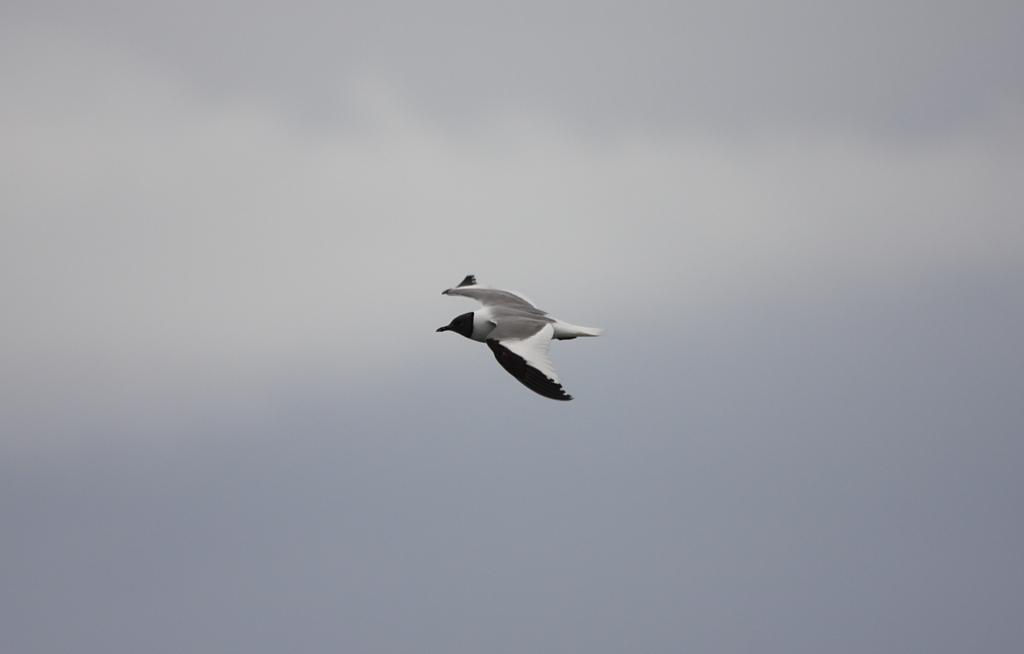
Steaming south, we could see the trawler in the distance and it was surrounded by birds..... a bit too distant to tell exactly what was there, but it was a good sign..... As we got closer we had a distant view of a Pomarine Skua coming away from the vessel, so we knew that it had been attracting the birds, fingers crossed there would be something good in the mix. A few minutes later and Matt Eade gave the shout..... "Sabs!".... (up until then he wasn't feeling 100% due to sea-sickness but funny how that was all forgotten as the bird came nearer!) Everyone looked in the direction that he was pointing and sure enough flying over the sea next to us was a full adult summer Sabine's Gull. This was another new bird for me (and for several others), I've missed several over the years and it was worth the wait, this bird was cracking, delicate bouncing flight, dropping down to hover over the surface to pick bits off the surface and the striking plumage of the back and as it came past the boat at close proximity, smiles broke out amongst us all.

Sabine's Gull (Xema sabini)
Reaching the trawler there were hundreds of gulls flying around the back of the boat, a few European Storm Petrels in the wake, but nothing out of the ordinary in the first instance. A few minutes went by while we were all scanning through the birds present when Higgo piped up..... "Great behind the trawler".... sure enough the Great Shearwater was drifting over the swell, a bit further back than the rest of the flock. The views we had were superb, it's not often you get the chance to see these pelagic species so close and for a good half an hour it cruised around us before disappearing off. After that it was time to head back to land, up to the campsite to drop off our gear, where I saw Barry and Lewis's tents, glad to see that they had arrived I let them know we were going off for yet more celebratory drinks and an evening meal.... a quick watch of the Arsenal match (better luck next time!), a quick chat to Barry and Lewis, then off to bed in preparation for the last full-day pelagic. Surely we couldn't do better than we had over the last couple of days out at sea?!
Great Shearwater (Puffinus gravis)

Saturday, 20 August 2011

July and August Update - Post 3 - A weekend on the Scillies (Day 1)

As I said before in my previous post, the seawatching on PG had whetted my appetite for the 13th August and the start of my weekend on the Isle of Scilly going on a boat hoping for close views of shearwaters, skuas and petrels. Everyday talking to Tom (who had been on the Scillies birder pelagics before) and listening to him tell me what he'd seen from them gave me a huge feeling of anticipation. To add to it, Barry Embling, a good friend of mine from Gloucestershire and Lewis Thomson, one of Barry's, were coming down for the pelagics too.

On the morning of the 13th, I got up, got my stuff packed and headed off for Penzance to get to the quay to catch the Scillonian boat. On the way I received a text from Barry to tell me that he'd been stuck in a traffic jam on the M5 and not moved for 3 hours.... he and Lewis weren't going to make the boat..... disaster..... No number of frantic phonecalls to the ticket office or anywhere else made any difference, they couldn't get their ticket for the boat transferred onto the helicopter or plane as the weather was closing in and all flights had been cancelled.... the only thing they could do was find a place to stay overnight and catch the ferry in the morning and hope they could transfer their pelagic booking to the next day.

That left me on my own.... but as I stood on the quay, feeling pretty gutted for Barry and Lewis (and feeling sorry for myself being on my tod), I spotted a couple of guys with binoculars round their neck, so I thought I'd go and introduce myself so I'd at least have people to talk to on the crossing. It turned out to be Dave and Barry Bradnum, a father and son team who were friends of none other than Tom! After a quick handshake and a chat we boarded the boat and before long we were setting sail.

The crossing was pretty uneventful apart from a rather good bacon and egg roll, a few Manx Shearwater, Storm Petrels and a single Sooty Shearwater to entertain us on the 2 and a half hour crossing, but I did manage to find out that there was going to be a short pelagic going out that night at 5pm which I hadn't known about. With Barry and Lewis stuck on the mainland I thought I'd take the opportunity to go out.... maybe heighten the chances of seeing any of the 'holy grail' species..... Wilson's Storm Petrel or even Fea's Petrel.

After arriving on St. Mary's I wandered up to the camp-site at the Garrison to find a space to pitch the tent, however, when I got up there the site was fully booked...... ah..... should have thought about that! Luckily, a familiar face appeared from around the corner.... Mat Meehan, the Retail Manager at Newport Wetlands. I'd previously met him up on the Blorenge in Gwent twitching the Mamora's Warbler last year, then on another twitch later on in October... the American Robin at Exminster Marshes RSPB. His group were just arriving and we decided to try and get me in with their booking.... thankfully it worked and with the tents put up and another quick meet and greet, we all set off to the quayside for the evenings pelagic.

Herring Gull (Larus argentatus)
As we went out, Bob Flood explained what we were going to do.... steam and chum on the way out to the area known as the 'Wilson's Triangle' - 6-7 miles south of the Scillies - where we would stop the engines and drift, chumming as we went to try and entice the Wilson's Storm Petrel - the target bird of the evening. The steam and chum on the way out did well for picking up gulls and gannets, but it was looking pretty quiet until a Balearic Shearwater was found shearing the waves in our wake, picking up little morsels from the chum.
Balearic Shearwater (Puffinus mauretanicus)
The shearwater gave great views giving us the chance to really get to grips with it's identification pointers, the dusky sides, chin and underwings, more brownish plumage and a more dumpy appearance than the very similar Manx Shearwater. Balearic Shearwaters are a species that are not doing well across the world - in fact they only breed on the Balearic Islands which are an archipelago in the western Mediterranean Sea, near the eastern coast of the Iberian Peninsula. - as their population has suffered a massive crash mainly from predation from Black Rats and domestic cats. With only an estimated 2,000 pairs left in the world they have been categorized by the IUCN, (International Union for Conservation of Nature), as Globally Critically Endangered. They are seen around the south coast of Britain more frequently due to changing sea temperatures, which has led to Seawatch SW starting up an observation scheme to try to find out more about these birds' movements. Check out their website here.

European Storm Petrel (Hydrobates pelagicus)
After watching the shearwater for a while we eventually made it to our destination out in the middle of the sea. Joe Pender (our skipper) switched of the engines and soon the boat was in a state of drift, rolling over the 2m swell, pitching this way and that. Luckily my sea-legs aren't too bad so I coped pretty well, but for a few on board the movement was a little too much and they were left with heads over the side adding to the chum slick. The chum was attracting the birds though, European Storm Petrels with their highly developed sense of smell (they can smell the chum from 20 miles away!) were floating in, so we hoped it was just a matter of time before a Wilson's showed itself.


Wilson's Storm Petrel (Oceanites oceanicus) showing the pale carpal bands.
Twenty minutes later and the shout from Bob.... ''Wilson's coming in.......'' mass scramble..... everyone poured over to the side of the boat to get a view of the bird and for 15-20 minutes the Wilson's showed fantastically well, at one point coming no more than 4 ft from the back of the boat.... Awesome - a new bird for me and to see it so well, it gave the chance to see the main ID point of this tiny little bird (no bigger than a Swallow) like the pale carpal bands on the top of the wings and even the yellow webbing in between in toes! Superb.

With everyone thoroughly pleased with getting the Wilson's, it was back to base and down to the pub for a couple of celebratory pints and chat about the day and what we could expect from the all-day pelagic in the morning.

Wilson's Storm Petrel (Oceanites oceanicus) showing the yellow webbing

Thursday, 18 August 2011

Update of July August - Post 2

So the Plain Swifts ended my last blog entry which were on the morning of the 29th of July, so I'll start with the new post with the afternoon of the same day. After reporting my sighting of the swifts to Rare Bird Alert to put out on the pager system, another message from Cornwall appeared on my screen: Cornwall - BLACK KITE flying over Lands End Aerodrome at 11.58am. Funnily enough this came through at 12.20pm as I was sitting in my caravan no more than 2 miles from there and had driven past the aerodrome at the time the bird had been seen.... typical. Most Black Kite sightings are of birds flying through on migration and they don't tend to hang around but as it was just up the road I thought I'd go and have a look around just in case it was still in the area.

Black Kite (Milvus migrans)
I pulled up into the lay-by opposite the airfield and had a quick scan and saw a bird of prey in the distance which I thought may be the kite, so back in the car and off to the other side of the valley to see if I could get a better view. As I parked up by Bosavern Community Farm, the bird I had seen in the distance was drifting closer.... definitely a different shape than Common Buzzard but it was head on, so I couldn't see the tail to be certain. As it came closer and closer the features became more and more apparent and soon the kite was flying no more than 40m above my head. Brilliant. For the next 2 hours I stayed watching it following a tractor in the next field as it cut the hay, exposing small rodents for the bird to pounce on. It showed really well before floating high and disappearing over the hill towards Newbridge, but not before a guy called Adam Hartley, whom I met in the spring in one of the valleys looking for a very secretive Melodious Warbler, turned up to watch it for a while with me.
Black Kite (Milvus migrans)

The kite hung around for nearly 2 weeks before it headed over to Drift reservoir, on the outskirts of Penzance, where I think it's still floating about, but proving a little harder to locate.

With the weather turning towards the south-west a couple of days later I decided to give Porthgwarra a bit of a go to see if any seabirds were passing through. Before I popped down there I had to nip into Penzance and I thought I'd drop past Drift to look for a Wood Sandpiper that had been reported there..... Bad decision!!! Pager message: Cornwall - ATLANTIC PETREL seen for 5 minutes around the Runnelstone bouy before landing on the sea and lost to view at 11.32am. I couldn't believe it..... another 1st for Britain and I decided against going there before Penzance..... 20 minute later I was sat on the cliff-top with several others including the Seawatch SW team (who had first seen the bird and reported it), intently staring at the sea in the vain hope that it would be relocated.... alas, 3 hours later..... nothing. It did, however, give me a chance to meet the Seawatch guys who I'd been meaning to see a few weeks earlier, but not had the time, and chat to John Swann - a Porthgwarra regular.


Fox (Vulpes vulpes)
Fox (Vulpes vulpes)
I decided over the next few days to spend more time down at P.G and help out with the Seawatch study. I spent most mornings and evenings (those where I wasn't working at the hostel or ringing) sat with Tom McKinney, the seabird volunteer, counting whatever went through. We had a pretty good few days, dark and light phase Pomerine Skuas, Roseate Terns, Balearic, Manx, Sooty and Corys Shearwaters which got me thinking about the weekend that I was going to spend on the Scillies going out on a boat to try to get closer views of some of these South-West specialities.  Every night though it was something else that was keeping my attention when I went back to the car.... a very confiding Fox cub, almost fully grown, who would come almost up to your feet to see what bits were left by holiday makers in the car-park.

Wednesday, 17 August 2011

July and August Update - Post 1

So....... over a month I've been away from the computer with scarcely a moment to breathe with all the goings on down here in Cornwall.... the next few posts will (hopefully) cover it all, but if I miss anything out, I guess you wouldn't know anyway!

Swallow-tailed Moth (Ourapteryx sambucaria)
Since my last post I've been incredibly busy ringing, helping out with Seawatch South-West, hunting butterflies, trapping moths and even getting over to the Isles of Scilly for a few pelagics. During that time there have been some incredible moments and I've been fortunate to meet some brilliant friends, old and new.

During the rest of July and into early August the weather has been a little turbulent, some really nice sunny days, some not so and pretty wet which has meant my moth trap hasn't seen the light of day (well.... night) for most of the time. I have managed to get it set up a few nights, hoping for the odd migrant moth but the main new ones I've been getting have been pretty standard fair.... very nice moths though like the Swallow-tailed Moth, Rosy Footman, Purple Thorn and of course the regular hawks.
Elephant, Poplar, Lime and Privet Hawk Moths (L to R)


Rosy Footman (Miltochrista miniata)
Purple Thorn (Selenia tetralunaria)
It's been so busy down at the Youth Hostel with loads of campers coming down, that I've felt a little worried about leaving the trap out too much either, but on the odd occasion I've been doing my RSPB thing and giving morning talks on the nights catch for anyone who's interested. As it quieten down in the next few weeks I'll leave it out more often (weather-dependant) and hope for something like a Silver-striped Hawk Moth to come in.

Wood Warbler (Phylloscopus sibilatrix)

Green Sandpiper (Tringa ochropus)
This time of year is quite a special time down here in in the south-west, with the right winds anything can occur..... south-westerlies give us seabirds close to the coast, easterlies give us our migrant passerines so whichever comes our way I go to one of two places.... Porthgwarra for the seawatch or Nanjizal to go ringing for the birds passing through. We had some great easterlies in the end of July, so I spent alot of time going round the nets. Mostly we had Whitethroats, Sedge, Reed and Willow Warblers, Chiffchaff, Blackcaps with the odd surprise like a Wood Warbler that popped into the net on the 9th. They are probably my favourite of the Phyllosc warblers... the bright lemon yellow supercillium (eyebrow) and upperparts mixed with the snow-white underparts really make this a little gem, so getting to see one in the hand was a real highlight. Kester (my trainer) is one of the only ringers in the country who rings Green Sandpiper as they come through on passage, so far we've done 47 this year which has beaten his personal record for his site. The way that they are caught is by a spring trap, which is left on the floor inbetween a line of chicken-wire to funnel the Green Sands over the tripwire releasing the trap over them.
Green Sandpiper (Tringa ochropus)

There was to be quite a huge surprise when I went down to the valley on the 29th though, on the way I found a flock of 50 hirundines - Swallows, House Martins and Swifts - flying over hawking for insects. As I watched them, 2 smaller birds zipped straight through the middle only 30m above my head. In appearance they looked like Swifts but with thinner wings and a more attenuated body. As one dived sideways to catch an insect the notch in it's tail could be seen clearly and it was much deeper than that on the Swifts. With most small swifts, their rump is usually white, but these birds were uniform brown all over. This left me reeling.... I continued to watch them as they disappeared into the distance, memorizing everything about them that I could..... Running back to the car with the images flashing through my head I couldn't think of what they could be, until looking through my Collins bird guide and getting to the swifts I found them staring back at me...... Plain Swifts..... $*@#...... These birds have been claimed in Britain before, but no records have ever been accepted..... I don't know what my chances are of mine being accepted either, but I can't be more certain of their identification. If it does go through it'll be a ''first for Britain''.... something that I've wanted to find as a boy.... we'll just have to see in the next few months if they go through.
Plain Swift notes


Monday, 18 July 2011

Maybe the storms aren't so bad....

Since my last post it's been sunshine all the way, the hottest week of the year so far, down at Land's End the seas have been flat calm and we all thought that we'd be swarmed with basking Sharks left right and centre. The first day it seemed as though our predictions were right, with at least 8 sharks drifting around the coast including 4 in the bay right in front of the hide.

Basking Shark (Cetorhinus maximus)
We even had a shark approximately 1.5-2m long (so a wee baby!) which we think is one of this years youngsters and we've been checking around to see if there have ever been reports of a birthing in Cornwall but with none found, this could turn out to be the first confirmed Cornish baby shark!

Most mornings, whilst the weather has been so good, I've been out with my ringing trainer Kester down one of the nearby valleys - Nanjizal. Mention the name of this place to bird-watchers anywhere in the country and you get a glassy-eyed reaction from everyone.... it's one of those very special places in Cornwall that, in the past, has turned up some unbelievably rare birds like the first British Alder Flycatcher in 2008 that had made it over to our shores from North America. Even the more scarce birds that many birders travel to see like Hoopoe, Wryneck, Melodious, Icterine and Aquatic Warblers turn up here annually and sometimes in 3's or 4's (at the right time of year).

Whitethroat, Sedge Warbler and Robin in the nets.

Even though most of the birds caught in the nets so far have been standard fare such as blue tits and blackbirds, chiffchaffs and willow warblers as it's still a little early for those scarcities to come in, we do get the odd cracker in the nets..... a bird that I watched zip into the net low down, which at first I thought was a Sedge Warbler, turned out to be a rather nice 3J Grasshopper Warbler (3J means that the bird is a youngster from this year and has not completed its post-juvenile moult - which in turn means that it hasn't quite got all of its proper feathers ready for its migration to Africa for the winter). The reason it's called a Grasshopper Warbler is because of its call, a long reeling which sound a little like a grasshopper (but goes on much longer!). They can be infuriating to see in the field as they skulk around in thick vegetation, so to get one in the hand and get up close and personal with one was great.

Grasshopper Warbler (Locustella naevia)
It does get pretty busy down there in the mornings too - in 3 hours we had 210 'new' birds (that's ones where we put a shiny new ring on its leg) and 137 re-traps.... between two of you its a little hectic getting that lot out the nets! Recently it's quietened down though now as migration is just starting, the numbers of tits going down and numbers of warblers going up.... a good sign.

Male Silver-studded Blue (Plebejus argus)
Male Silver-studded Blue (Plebejus argus) underside
I've also been keeping going on my butterflies during the settled spell. I spent a day walking around the Towans which is an area of coastal dunes just north of Hayle looking for a very special butterfly, the Silver-studded Blue. Other places that I have searched for them I've only managed to find them in reasonably
 small numbers (<20), but here they were everywhere.... I lost count after 300! The south-west tip of Cornwall is great for these little gems, but countrywide few strongholds remain.... to my knowledge the area around Studland Heath in Dorset and Prees Heath in Shropshire are the only main areas that you stand a good chance of seeing one of these beautiful blues. The reason they are called 'Silver-studded' is due to the markings on the underside of its wings which show silvery-blue metallic spots which can be found next to the orange at the edge of the hindwing.


Skylark (Alauda arvensis)
Also there were some other bits and pieces whilst I wandered around, Dark Green Fritillaries, Small and Large Skippers and a few migrant Red Admirals and Painted Ladies. I even had my own theme tune as I walked around the site, well I liked to think so as I listened to the constant sound of Skylarks that breed in the area.... usually it's pretty tricky getting close to them on the ground, as they hide in the long grass then fly up just as you get close, but spying one descend, I kept my eye on when it went down and crawled on my front until I was only a matter of feet from where I thought the bird was hiding and waited, hoping that it would show itself. After 30 minutes I started to think that the bird had run out the other side of the grass, but just as I was getting up, out he strode to the edge of the grass, no more than 10 foot from me, after firing off a few shots he about faced and disappeared.

The good weather held up for a while, peaking on a day with no wind, no clouds and a scorching 28 degrees, which was great for all of the holiday revellers coming down to the hide, but even thought the sea was so calm we hardly saw anything. The only sightings of note were the previous Basking Sharks but with a turn in the weather, we had a surge of wildlife and on the 6th of July it went a bit crazy. When I got down to the hide there was a strong SW gale blowing around force 6-7 and the sea was choppy with white horses breaking everywhere. I really felt as if we were going to be right out of luck seeing anything and I think that the tourists thought so too as no-one bar a single guy from Norfolk decided to brave it. It was a shame they didn't, as during the day we got to see a fantastic array of seabirds including no less than 58 Cory's Shearwater, 8,000+ Manx Shearwater, 2 Sooty Shearwater, 15 Storm Petrel and 2 White-beaked Dolphin.... who says that wildlife's easier to see when it's sunny.... it was a brilliant day as I'd never seen the White-beaks or the Cory's before, so two new wildlife ticks for me!

This weather has continued since then, with no signs of letting up, but hopefully it will so we can have a little bit more summer-time and also we can get the nets back out.... it's been too windy so far, but next week.... who knows?!