Saturday, 22 October 2011

A Scilly rush

A few phoncalls through the week to my boss Matt Brierley in between going down to the levels sorted out a quick visit back to Cornwall for a quick day trip to the Isles of Scilly for one last autumnal holiday before the Starlings started up in earnest.

Before we went though, we did have a day of excitement on the RSPBs Ham Wall reserve where I am now based...... whilst stood in the car park, a guy came up to Jen (my new colleague) and me and told us he'd just seen a small heron with greenish legs and white wings sat on one of the crossbeams at the first viewpoint for 45 minutes before flying off further up the reedbeds. I had left my camera at home, but Jen had hers so she thrust it in my hands and I sprinted down to try and find the bird again. The only thing we could think it could be was a Squacco Heron.... a rare Mediterranean visitor. I couldn't see anything, but mentioned it to a birder at the second viewing platform who said he'd keep his eyes peeled as I went to check the reedbeds on the other side. After checking them to no avail I went back to the main track where I was met by the birder I'd just spoken to. Just after I'd left him the bird had come out of the reedbed and flown further to the right. We bombed it down to the extremity of the reserve and after a half an hour wait we were rewarded with a quick flight view as it made it's way back to the left. I managed to grab a very distant record shot, but you can see the dark back in between the white wings which should hopefully get it accepted by the Somerset Rarities Committee.

Squacco Heron (Ardeola ralloides)
Anyway, last Tuesday night I arranged with Matt to pick him up in Okehampton to make our journey down to the Cornish coast. By 10pm we were in the hostel, packed and ready for an intense 4-hour visit to St. Mary's. The next morning we were on the boat and setting sail by 9.15am after a hearty cooked breakfast.... along the way we picked up on a dark phase Arctic Skua sat on the sea as the boat went past and a distant Sabine's Gull.
Arctic Skua (Stercorarius parasiticus)
Unfortunately the Scillonian III really lived up to its nickname ''the vomit rocket'' and pitching and rolling all over the place caused Matt to turn pale and it was downstairs for a kip and an attempt at recovery. Thankfully, half an hour later and coming into the quayside on Marys, Matt really perked up.... and so as we stepped off the boat.... the game was a-foot.

The first port of call was to be the bulb fields by Borough Farm to try and see the juvenile Upland Sandpiper that had been there for just over a week. Thankfully a few people had the same idea, so we grabbed a taxi and got a lift to Maypole. When we got there, the Sandpiper hadn't been seen all morning.... it had a habit of doing this, so we decided to go down the road to where a couple of Olive-backed Pipits were showing. OBP's tend to be nightmares... hiding away in long grass only giving a quick glimpse of a head above the vegetation..... not these ones.... as soon as we were there there was one sat on top of a furrow completely out in the open no more than 30 foot away..... Amazing. For quarter of an hour we watched both of them running through the grass, standing out in the open picking insects off the vegetation.

Olive-backed Pipit (Anthus hodgsoni)

Olive-backed Pipit (Anthus hodgsoni)
Due to our time limits we made a move to have a look for the Upland Sand again, but still no sign, so the decision was made to go to Pelistry Horse Stables which was just round the corner to try and look for a Red-throated Pipit which had been reported 10 minute before in a flock of Meadow Pipits feeding on the fields. By the time we'd got there however, there was no sign.... a Sparrowhawk had gone through over the field and put all the pipits up. We didn't have the time to wait around so we started back towards the bulb fields when a flock of pipits went over..... they all called like Meadow Pipits.... one of the guys who was walking with us had an iPhone with the Birdguides App and played the sound of Red-throat.... we definitely hadn't heard it in that flock.... but then as if it had been waiting for someone to play the call, the Red-throat flew over us calling (not a full call, but enough to know what it was) all on it's own too, so we knew we'd seen the right bird. A proper fluke! It quickly disappeared over the hill and was gone.

We left Pelistry and tried the bulb fields for what we said would be the last time.... we spent a good 20 minutes staring at nothing until a birder near us shouted out that he'd found the Upland..... it wandered closer and closer through the field, giving us some brilliant views.... stretching up it's neck accentuating just how small its head was compared to the rest of its body.

Upland Sandpiper (Bartramia longicauda)

Upland Sandpiper (Bartramia longicauda)

Upland Sandpiper (Bartramia longicauda)
After watching the yankie wader (the 11th species I'd seen this year!) wander around and head back to the far end of the field we called another taxi to ship us down to Porth Hellick where there was a first-winter male Bluethroat that was meant to showing really well. Getting to the beach we found a bloke that told us that he'd been just watching it hop around his feet, his tripod had fallen over almost braining the thing.... but instead of flying away, it had just hopped out of the way and carried on feeding! It had, however, just hopped round the other side of the bushes that we were watching. So we scooted round the other side and found the bird almost completely hidden away in the undergrowth. We crept closer and it din;t budge, it just watched us. In fact it was so unconcerned by us that it took a couple of minutes kip with us no more than 5 feet away... unbelievable! After a little while it woke back up and started to feed, perching out in the open on top of a rock before it flew up the beach leaving us with only an hour before we had to catch the boat.

Bluethroat (Luscinia svecica)

Bluethroat (Luscinia svecica)

Bluethroat (Luscinia svecica)
We had a quick effort to try and find the Wilson's Snipe at Lower Moors on the way back, but unfortunately the hide was full of people who were more intent in having the loudest conversations they could possibly have, so (rather suprisingly) the bird either wasn't there or wasn't showing.

We made it back to the quayside and the boat pulled out of the harbour, the islands getting smaller and smaller as we neared the mainland, but we were treated to more Common Dolphins messing around the boat and a pretty spectacular sunset over the sea so all in all we'd had a cracking day.

Common Dolphin (Delphinus delphis)

The departing sunshine

Friday, 21 October 2011

Migration is here.... well......kind of...... (Part 2)...... (although it is really getting going now!)

So..... into the next week..... up to our necks in it?!? Yeah right.... the winds turned again...... westerlies..... good for American stuff, but with the jet stream well and truly lumped over northern Scotland and the Northern Isles, it looked pretty unlikely we were going to be on the receiving end of another Dendroica warbler or Nearctic wader.... but you never know with nature..... especially migration.... things never turn up where you expect them to.

So to pass the time I popped over to Sennen to have another go with the Snow Bunting. This time the bird was easier to find, but a touch more wary. Instead of leaving the car I decided to use it as a hide and roll up to the bird with the engine off - hopefully it wouldn't be that bothered..... thankfully it worked quite nicely, not mega close, but close enough to get some decent portrait shots.


Snow Bunting (Plectrophenax nivalis)

Snow Bunting (Plectrophenax nivalis)

Whilst up at the top a pager message came on saying that the Dark Mottled Willow was being put on show at the local shop down at the bottom of the hill. A quick phonecall to Martin informed me that Steve Whitehouse was showing a few other decent migrant moths in the harbour car park next to where the Willow, so I started up the engine and made the quick 2 minute journey down past the seafront to where a few people were gathered and went to join in. There were a couple of Dark Sword Grass, a Vestal (personally one of my favourites), a few Rusty-dot Pearl and a Clancy's Rustic being shown off by Steve Whitehouse which were really great to see, but we were told about a moth that had turned up down at Porthgwarra whilst I was in Somerset... a Crimson Speckled... an absolute cracker of a moth that is one of the top species that I really wanted to see.... typical, I was just going to have to turn my moth trap on every night and hope that another one would show up, but with only just over 100 sightings of that species from 1900-2003, (a few more have turned up since then but still no more than 40 individuals), it seemed pretty unlikely.

Clancy's Rustic (Platyperigea kadenii)

Rusty-dot Pearl (Udea ferrugalis)

Vestal (Rhodometra sacraria)
I spent a while looking through the different moths learning loads from Steve before I set off up the hill to have a wander down the valleys..... but before I got there I received a text from Kester telling me about a Tawny Pipit that had been found on the bulb fields at the end of the Nanjizal valley. I managed to get down there within half an hour, even having the time to find a Clouded Yellow butterfly perched up on a bit of grass on the stone walls along the track (there'd been a fantastic mini-explosion of them during the last couple of days.... I'd seen 14 the day before, but all fly-throughs).... after taking a few pictures of this stunning butterfly I went on to the fields. I managed to get a couple of brief flight views of the large pipit but just couldn't locate it on the floor which was a shame, but still good enough views to see the size in comparison to Meadow Pipits and heard its diagnostic sparrow like call which confirmed its identity but I just couldn't get close enough to get any photos.

Clouded Yellow (Colias croceus)
I stayed until 4pm until it was time for me to leave and get to work at the hostel.... only getting one more very brief frustrating view of the Tawny Pipit. It was an early start the next morning to go ringing down at Nanjizal and with the winds still coming from the east, hopefully we'd find a few good migrants in the nets. The first couple of rounds were pretty quiet, a couple of Chiffchaffs and Willow Warblers but on the third net round we ended up with a couple of goodies.... a new Cetti's Warbler and a cracking male Firecrest. Brilliant stuff.

Firecrest (Regulus ignicapillus)

Firecrest (Regulus ignicapillus)

Firecrest (Regulus ignicapillus)

On the way back from ringing I had a text from John Swann telling me that a Convulvulous Hawk-moth had found its way into his trap overnight, so I made my way over to his house to have a look at this monster moth.

Convulvulous Hawk-moth (Agrius convolvuli)

Another text, this time from Martin, he'd had another good couple of migrant moths overnight so it was off to his for a quick cuppa. When there he showed me L-album Wainscoat, Dark Sword-grass and a Ni moth..... the Ni had managed to make its way to our shores from southern Europe or North Africa.... an amazing journey for such a tiny animal.

Dark Sword-Grass (Agrotis ipsilon)

L-album Wainscoat (Mythimna l-album)

Ni Moth (Trichoplusia ni)

After spending a while photographing the moths it was time to go and pick up Ross from the train station. He was going to spend a few days down here in Cornwall so hopefully we could find a few bits and pieces around the place.

The first couple of days were pretty quiet, but we did manage to get pretty close to a couple of Dotterel that had turned up on their way down to Africa at Polgigga.... we even managed to walk one into a spring trap to ring it!

Dotterel (Charadrius morinellus)

Dotterel (Charadrius morinellus)

Dotterel (Charadrius morinellus)

Dotterel (Charadrius morinellus)
With no new birds around we resorted to spending time with some that had been hanging around for a while..... the Pectoral Sandpiper at Marazion was next on the list, so we went down there to have a look..... we got down there and after scanning the far banks and not finding the bird we thought it was not going to be any good..... until Ross looked down on the shore next to our feet and there it was..... no more than 5 foot away. It was so close we ended up having to take photos with our macro lenses!

Pectoral Sandpiper (Calidris melanotos)

Pectoral Sandpiper (Calidris melanotos)

Pectoral Sandpiper (Calidris melanotos)
We left the little wader to feeding up for its migration and went back to the hostel..... we stuck on the moth trap and went to have a bite to eat. When we went out for our first check on the trap at first it was the same old moths, until Ross noticed on a piece of grass next to the trap...... a Crimson Speckled!!! An incredibly looking moth, that from the 1900's has only been recorded around 150 times in Britain!

Crimson Speckled (Utetheisa pulchella)

Crimson Speckled (Utetheisa pulchella)

The next day we went back to see the Dotterel again and while we were there we had another 5 fly over and a couple of Buff-breasted Sandpiper on the field with the original Dotterel.

Buff-breasted Sandpiper (Tryngites subruficollis)
The afternoon we spent looking at the 3 Black Kites that had been hanging around near Drift, a really nice sunny afternoon, and we ended up having some cracking views.

Black Kite (Milvus migrans)

Black Kite (Milvus migrans)
Before it got dark we heard about a Wryneck showing well down on the Lizard... with this being one of Ross's target birds to see we set off. On arrival, we walked round the corner coming across a guy pointing his camera into the bushes...... sure enough, the Wryneck was there sitting proud on top of some blackthorn. It dropped down into the grass and was lost to view, but as we stalked across to try and find it again... one flew up..... then another!!! We wandered around to relocate them and finally managed to creep up behind on sitting in the gorse to get some decent shots!

Wryneck (Jynx torquilla)

Wryneck (Jynx torquilla)
Before I had to get Ross to the train station to get him back home we caught up with the Rose-coloured Starling in St. Just.... having it show off brilliantly well.

Rose-coloured Starling (Sturnus roseus)

Rose-coloured Starling (Sturnus roseus)
A brilliant week.... and I couldn't believe that my time was up... my contract at Ham Wall was starting..... but hopefully... if it was possible.... I'd be back in Cornwall, maybe even to pop on to the Scillies one last time for the autumn.

Monday, 10 October 2011

Migration is here.... well.... kind of.... (Part 1)

After my manic day trip to the Isles of Scilly it was time to relax a little.... well.... I thought I'd be able to, but it was yet another trip back to Somerset for my girlfriends birthday (not so much of a hardship to be fair) which was great albeit far too brief, then back down to Cornwall in preparation for the last couple of weeks at the Lands End Discovery Centre. The weather down here has been terrible for the past weeks.... more often than not the sea being totally obscured by the fog (so too my hand in front of my face!).... but with the scorching weather we're having, tied in with the easterly winds, the migrants have been starting to make their way into the valleys.

Driving back from Somerset I received a very exciting text..... Kester was out ringing and he'd had something fly into the nets.... a Red-eyed Vireo!! These little gems are passerines from America that have either been blown off-course by strong westerly winds or for some reason have decided to 'reverse migrate'.... travelling in the opposite direction they would normally do so and thus end up on our shores. Anyway, I wasn't going to be able to make it down to the ringing site as I was 2 hours away.... far too long for Kester to hold it in the bag, so I kept my fingers crossed it would hang around for me to see it or possibly catch it again. So I carried on to Lands End and after getting back to work and having to spend the whole day talking to a very small number of visitors I met up with John Swann (a local birder) and Lewis Thomson who was down for the week from Gloucestershire. We decided to have a look for a juvenile Rose-coloured Starling that had been seen on the wires at the entrance to the Lands End complex. Unfortunately it didn't show after an hour or so of scanning through the Starling flock so just before it got dark Lewis and I thought we'd go and see a Pectoral Sandpiper (yes... another American wader!!) which was hanging around behind Tregiffian Farm on the smallest patch of water I have ever seen a wader on! It showed really well but the light was fading fast and it was just a little too distant for my lens to get any images, I'm sure Lewis will have done with his monster Canon 500mm prime lens and Canon 1D Mark 4 body........ (slightly out of my price range by 99% of the cost!!!)

The next day I caught up with a rather bedraggled looking Rose-coloured Starling in the mist and drizzle.... it showed very well feeding on the deck with a small flock of local starlings..... nice to see but the light was terrible for photography so only managed a couple of half decent record shots.


Juvenile Rose-coloured Starling (Sturnus roseus)

Juvenile Rose-coloured Starling (Sturnus roseus)
Lewis and I planned to have a look down Kenidjack Valley during the afternoon after work as the winds were still coming from the south-east, hopefully it would have brought something in overnight. Walking down the valley, the wind was up and the fog was down so the birds (if there were any) we keeping their heads down in the bushes.... it didn't look like we were going to see anything. As we neared the end of the valley we notice a flick of movement in a hawthorn bush on the opposite slope.... after a moment or two a bird perched out in full view, a female Pied Flycatcher.... that was a good sign that migrants were around, so feeling a little more motivated we carried on to the house at the end of the valley.

The 'last house' is a remarkable place.... their garden is just a tangle of fantastic brambles, a few sycamores, pines and other bushes all sheltered in the valley. It is a place of folklore for birders as it is where, just over 20 years ago, the UK's only Yellow-throated Vireo turned up..... the locals still remember that day as the visiting twitchers (1000's of them) caused pandemonium..... the poor lady living in the house woke up in the morning, drew back the curtains and was greeted to a view of a massive crowd of birders with telescopes and binoculars trained towards the house..... a little bit of a shock! People were stuck in the valley as there were cars everywhere..... chaos reigned!

Thankfully (or rather a shame as it meant that nothing amazing had been found there).... only Lewis and I were stood at the bottom of the garden looking up the slope to see what was moving through the trees (if anything) when we both saw a bird hop up onto a gorse bush.... getting our bins on it we saw a medium sized bird, short bill, and very cryptic plumage.... we both knew what it was straight away.... Wryneck.... brilliant stuff. We watched it as it got mobbed by the local Blackbirds, Chaffinches and Great Tits.... (I'd heard about this happening to Wrynecks but never seen it before).... until it had obviously had enough and dropped into deep cover where we lost it to view. We stayed for another half an hour to see if it was going to re-appear, but unfortunately nothing so we made our way back up the valley to get back to the cars.


Wryneck (Jynx torquilla)

The next morning I was out with Kester doing the rounds at the nets and after a couple of hours of standard bits and bobs, he rounded the corner with a big smile on his face.... I knew what this meant.... he handed me the bag he was holding and said ''You might want to get this out a little carefully!''. I stuck my hand in and felt a smallish bird wriggling it's way around my hand..... a couple of seconds later I had it in the ringers grip and pulled it out of the bag..... we'd re-trapped the Red-eyed Vireo!! Seeing all the I.D points in the hand was superb.... the stunning head pattern, the yellow vent under the tail.... a proper cracker of a bird. See for yourself!


Red-eyed Vireo (Vireo olivaceus)

Red-eyed Vireo (Vireo olivaceus)
Even though the weather had been beautiful during the morning, it gradually worsened over the day, the fog coming back in again, so with no-one coming to the hide I closed up and went down to Nanquidno where a Melodious Warbler had been reported in the morning. Lewis (who I'd met looking in vain for the RC Starling) followed me down, and pretty much as soon as we got out of the cars and walked round the corner the bird was showing out on the branches of the blackthorn. Unfortunately the weather was rubbish and the bird only showed for about a minute before it dived across the track and into cover disappearing for the remainder of the afternoon.


Melodious Warbler (Hippolais polyglotta)

The rest of the week was pretty quiet, nothing much happening apart from the odd Pied Flycatcher here and there until the 29th. The Indian Summer had finally reached us with glorious sunshine and promises of 26 degrees.... perfect.... and it was a day off too.... even better.

I started off going ringing and we re-trapped the Vireo for a 3rd time, but also got my hands on a couple of decent migrants... a juv Pied Flycatcher and a imm male Redstart..... the latter was superb, showing off it's bright orange tail as it sat in the hand... a good start to the day, maybe there'd be a bit of movement?


Red-eyed Vireo (Vireo olivaceus)

Pied Flycatchcer (Ficedula hypoleuca)

Redstart (Phoenicurus phoenicurus)

Redstart (Phoenicurus phoenicurus)
 After we'd furled the nets and started to wander out of the farmyard we found a Turtle Dove sitting on the wires.... another migrant.... things really were looking up.


Turtle Dove (Streptopelia turtur)

I had to drive into St. Buryan to put some petrol in my car before I made my way down to the valleys for the day and on the way managed to catch up with one of the 3 long-staying Black Kites just on the edge of the village. I parked up, snapped off a few photos before the bird flew off then carried on.... nice. 

Black Kite (Milvus migrans)

On hearing that there was a Snow Bunting showing well down at Sennen car park I decided to pop down there to see if I could get any shots as usually these birds are pretty approachable.... but on arrival there was no sign of the bird. But with time to kill I sat down and waited.... I was pretty certain it would appear again as they tend to be creatures of habit and an hour later, sure enough, the bunting flew out of the long grass onto the gravel close to me.... I got down on my belly and crawled forward to grab some close ups.... it was a bit jittery and after a few minutes I realised why when over bounded a dog.... the bird zipped off into the long grass and that was that.... I'd have to try again another day if I wanted to get really close, but I was still pretty happy with the pictures I got.


Snow Bunting (Plectrophenax nivalis)

Snow Bunting (Plectrophenax nivalis)

Just about to get into the car I received a phonecall from Martin Elliot, a local birder/moth-er and renowned wildlife illustrator... (if you don't know his work, he did the gulls and skuas plates in the Handbook of Bird Identification for Europe and the Western Palearctic... which is a phenomenal book. He told me that he'd caught a very rare moth overnight, a Dark Mottled Willow, which he was going to take down to the Land's End Airfield to leave during the day at the cafe if anybody wanted to have a look at it and Colin Moore (another bird and moth man)... had caught a Slender Burnished Brass.... another cracking moth..... not quite as rare but still not exactly common! I told him I was going to check Nanquidno before I headed down to see the moths, at which point Martin said he'd meet me down there.

Arriving at Nanquidno I saw Steve Rogers having a look around the bushes near the car park and got out to have a chat with him. I hadn't seen him since we'd been on one of the Penzance pelagics a couple of months earlier, so it was nice to catch up.... whilst we were talking I looked over the some bushes that were just opposite Nanjulian Farm and saw a big orangey blob sat on the top..... picking it up in my bins it was a full adult male Hawfinch!! I know these are seen pretty much across the country and aren't seen as that rare a bird, but down here in Cornwall, they are few and far between.... so I text a few people to see if they could make it down, but I was out of signal in the valleys, and wasn't sure any texts would go through..... so I got on with watching the bird and hoped that somewhere my phone would find enough signal to let my text fly off to John, Colin and Martin.

The bird dropped into the bushes, so we took the decision to get a bit closer... and as we got round the corner, Steve picked it up again..... he fired off a few shots, but it dropped over the back before I could... you should see his pics... they are awesome!! (they should be with £10k worth of camera gear!) You can see them on his blog swopticsphoto.

It did re-appear on a bush round the corner and a few people like John and Martin actually managed to twitch it while I was still there..... but it was a cracking bird.... the best views of Hawfinch I've had for a long time as it munched away on the sloes.


Hawfinch (Coccothraustes coccothraustes)

Leaving the Hawfinch, John and I went up to Colin Moore's to see the two moths.... the Slender Burnished Brass was pretty stunning, with the glints of the green on its wings showing in different angles of light.... the Dark Mottled Willow was nice enough, subtly marked.... but with me being new into moths I didn't realise the significance of it until John told me it was only the 10th ever recorded in Britain.... quite something!


Slender Burnished Brass (Thysanoplusia orichalcea)

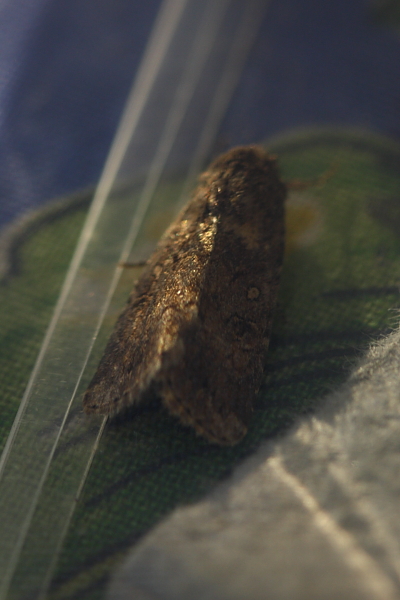
Dark Mottled Willow (Spodoptera cilium)
It had turned into a cracking day.... a bit of movement, some nice rares and chatting to some good people in great weather..... hopefully this was the real start of migration..... by the end of next week I was certain we'd be up to our necks in migrants....